
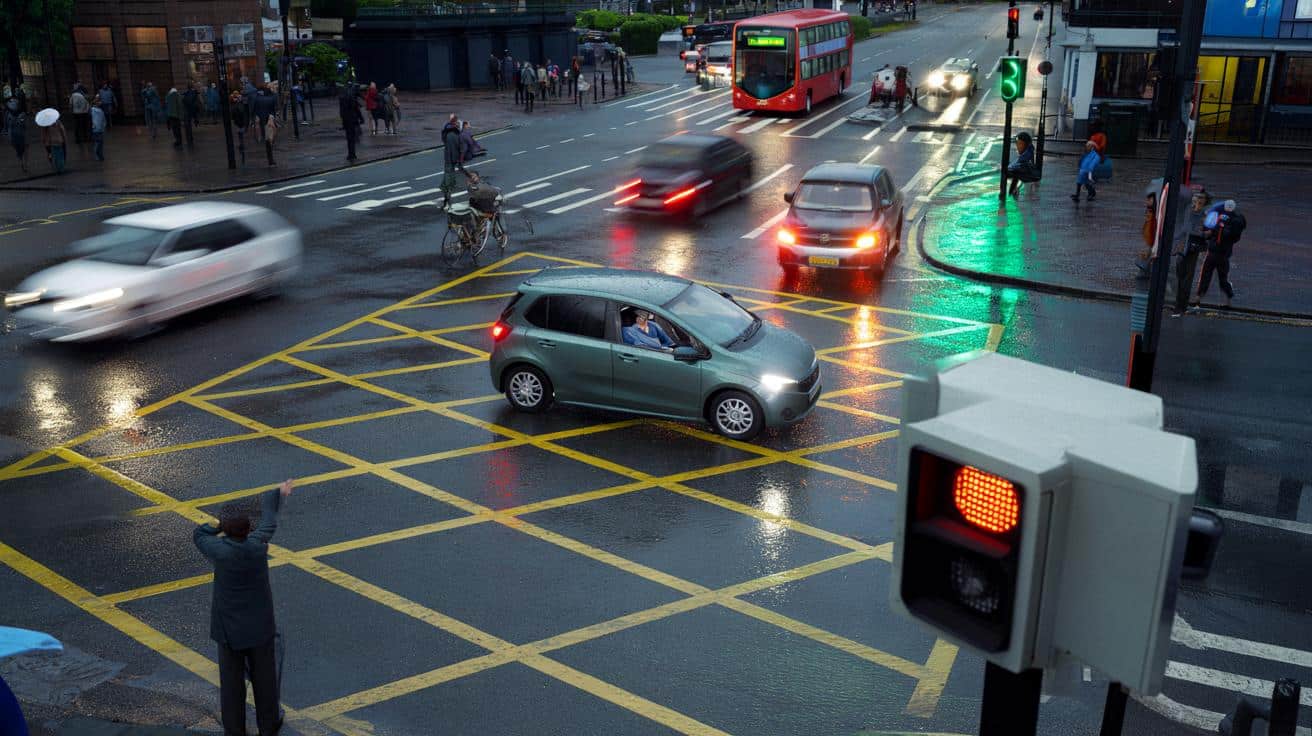
The yellow criss-cross looks like hazard tape laid across the tarmac. You edge forward because the light’s gone green and the car ahead twitches. Then it happens: the gap shrinks, your exit vanishes, and you’re a sitting duck in the box as the cross-traffic floods in.
That small misread could soon bite harder. Talk in Whitehall points to a 2026 shake-up that would turn “don’t block the box” from a wallet sting into a licence risk. Three points worth of risk. Think about that at rush hour.
On a grey Thursday in Manchester, I watched drivers treat the yellow box like a polite suggestion. Two rolled in on amber, one followed because the bus bay looked clear, and a fourth crept to the centre and froze. Horns, hands in the air, that sheepish shrug we all know. It looked sloppy, not malicious. It also gridlocked a whole cycle of traffic.
We’ve all had that moment when the car in front hesitates, and you read the gap with hope rather than certainty. The Highway Code’s Rule 174 is blunt: don’t enter the box until your exit road is clear. Right now that breach usually means a civil penalty charge, caught by a council camera. In London, it can be £160. Outside the capital, often £70. Early payment halves it. The rumoured twist is the one that raises eyebrows.
Here’s the nub. Ministers are said to be weighing a road-safety package for 2026 that would make persistent yellow-box blocking an endorsable offence. That would turn a camera-caught misjudgment into something that lives on your record. **Right now, a yellow box fine is a civil penalty, not points.** If the new rule lands as trailed, you’d still be fined—but you could also be hit with three points for entering without a clear exit. That’s a big cultural shift, and it changes how you judge a green light.
So what actually changes under the 2026 chatter? Think mechanics. Most councils in England and Wales already enforce box junctions under Part 6 of the Traffic Management Act. Cameras spot a stop inside the criss-cross and the back office issues a PCN. The proposed change would add an endorsable element—turning a simple PCN into a hybrid that logs points against your licence.
What makes that credible is the tech and the trend. Councils have rolled out more automated enforcement since 2022, and compliance jumped where cameras appeared. London showed the model years ago. Add a points risk and behaviour shifts faster, because insurance premiums and totting-up suddenly sit in the front seat. **If ministers go the endorsable route in 2026, three points per breach is the number being floated.** It’s not signed into law today. It is very much on the table.
There’s a human story behind the policy-speak. I met a delivery driver off Bishopsgate who racked up three PCNs in a month because a van ahead kept blocking loading bays. Each time he followed the green, each time the gap vanished. “I wasn’t trying to be clever,” he told me. “I just needed to turn left.” That nuance matters. A points-based rule will sting people like him unless the guidance is crystal clear on exceptions—like turning right when oncoming traffic is preventing the exit, which remains lawful. Policy has to meet pavement reality.
Let’s talk clarity. A yellow box exists to keep junctions breathing. When you stop across it, you suffocate the cross-stream. It triggers a cascade: longer queues, more risky lane changes, more horns, more frustration. *Read that again at the next set of lights.* The 2026 move, if confirmed, isn’t an act of revenue-raising so much as an attempt to change habits that haven’t shifted enough with fines alone. The legal gap to bridge is how a civil contravention becomes a points offence. That likely means new regulations or reframing the conduct to an endorsable category—while keeping the familiar camera-led process.
Here’s a clean, road-tested method to dodge the trap. Use the “one-car margin” rule. Before you cross the first yellow line, picture where your rear bumper will end up. If you can’t place your entire car beyond the far edge of the box with room to spare, don’t go. Count a beat—one elephant, two elephant—then roll only if the space survives that count.
Add a second trick: scan the far pavement, not just the tail-lights ahead. Buses pulling out, cyclists filtering, a pedestrian crossing flashing to green—these are your spoilers. Keep your wheels turning at walking pace when you do commit, so if the gap shrinks you can stop before your bonnet cuts the lattice. Let’s be honest: nobody does a mental geometry test at every junction. Do it at the busy ones, the camera ones, the ones with buses.
Most box junction traps come from social pressure, not recklessness. The light flips to green, the car behind puffs its chest, and you go with the flow. Breathe. Leave space. If you’re turning right, remember the exception: you may wait in the box if oncoming traffic or a vehicle ahead turning right is blocking you. That’s still lawful.
“I tell clients to treat a yellow box like a level crossing,” a motoring solicitor told me. “You don’t cross unless you can clear it. Green light or not.”
- Look for a full car length beyond the box before rolling in.
- Keep a creeping pace to avoid stopping dead on the hatch.
- Know the right-turn exception and use it correctly.
- If the exit depends on a bus or bin lorry moving, wait.
So where does this leave you as 2026 creeps closer? Somewhere between habit and law. Councils will carry on issuing PCNs today, and some already plan fresh camera sites at snarl-up junctions. If the points rule lands, insurers will notice, and that will nudge driving schools, fleet managers and everyday commuters to recalibrate. **Policy is slow until, suddenly, it isn’t.** This one touches millions of daily decisions at green lights and bottle-necked gyratories. It’s worth a chat in the car, at the depot, on the school run. The next time you face a glistening yellow grid in the rain, the question won’t be “Is the light green?” The question will be “Can I definitely clear it?”
| Key Point | Detail | Interest for the reader |
|---|---|---|
| The current rule | Highway Code Rule 174: do not enter the box unless your exit is clear; right-turn waiting is allowed | Know what’s enforceable today to avoid fines |
| What may change in 2026 | Proposal to add three licence points for blocking the box, on top of a fine | Your licence and insurance could be affected |
| Practical method to avoid it | Use the one-car margin and two-beat scan; creep, don’t commit blindly | Keeps money and points in your pocket—and traffic flowing |
FAQ :
- Is the “three points” yellow box rule already in force?No. Today, most yellow box breaches result in a civil penalty charge, not points. The three-point element is being discussed for 2026 but isn’t law yet.
- Can I ever wait in a yellow box legally?Yes. If you’re turning right and your exit is blocked by oncoming traffic or a vehicle ahead turning right, you may wait in the box. That exception still applies.
- How much is the fine right now?In London the PCN is typically £160, reduced by 50% if paid promptly. Outside London many councils set it around £70, also reduced for early payment.
- Could I get points today for box junction behaviour?Not via the standard camera PCN. In unusual cases, police could charge a separate endorsable offence like careless driving, but that’s different from a routine box-junction contravention.
- What if I was forced to stop in the box?Appeal with evidence. If a vehicle ahead broke down, an emergency vehicle forced a halt, or you were lawfully waiting to turn right, include photos or dashcam and explain clearly.







Is this actually becoming endorsable in 2026, or still just “being weighed”? When would the regulations be published, and will there be guidance on what counts as being forced to stop (e.g., emergency vehicle, sudden pedestrian)? Also, will councils need stricter camera verification if points are at stake?
So the yellow box is basically lava now? Guess I’ll count elephants at every green.