
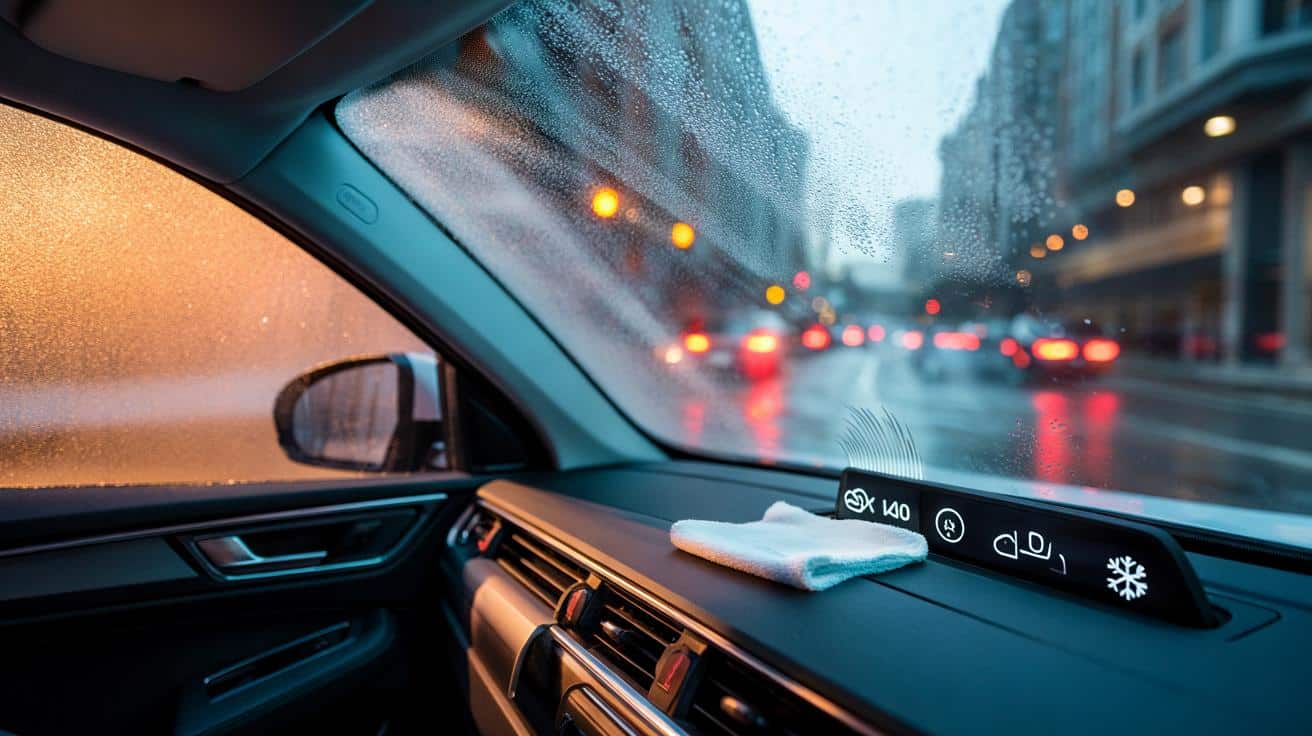
Cold breath meets cold glass, the view smears to milk, and the school run turns into a guessing game. “It’s not just a myth,” say the pros: a simple “2-minute rule” can clear a windscreen faster than panicked wiping and fogged-up sighs. Winter doesn’t have to win.
I’d scraped the outside ice like everyone else, but inside the glass bloomed white, a slow, ghostly curtain. The heater coughed warm breath, the clock dared me to wait, and the bus lane timer scrolled down like a dare.
I flicked a few switches that an old mechanic once showed me, cracked the side window a thumb’s width, and heard the pitch of the fan settle into a purposeful hum. The smear faded to a halo, then to nothing, as if the car had exhaled. In the rear-view, a line of drivers still rubbed their sleeves across the fog, going nowhere fast.
Two minutes.
The 2-minute rule: what it is, and why it works
Here’s the simple rhythm: engine on, demist button, A/C on, temperature warm not roasting, fan medium-to-high, fresh air (not recirc), windows cracked a sliver. Then wait two minutes and let physics do the heavy lifting. You’re not trying to superheat the cabin; you’re trying to dry it.
The trick is to dry the air, not just heat it. When air is drier, it can carry away the moisture that’s fogging your windscreen, and it does it fast. That’s the heart of the 2-minute rule an HVAC specialist spelled out to me: set the system to dehumidify and flush, and give it those 120 calm seconds to work.
Want a picture you can feel? Think of a winter Friday in Manchester: overnight rain, soggy mats, your coat still damp from the walk. You breathe into that cold cabin and the glass is colder still, so the water in your breath condenses instantly on the windscreen. Two minutes of drier, fresh air turns the tide. It’s not magic, it’s management.
What’s really happening on the glass
Your windscreen fogs when warm, moist air hits cold glass and drops below its dew point. That’s the threshold where water can’t stay invisible anymore. On a raw morning the glass might sit near outside temperature, so every exhale, wet shoe, and steaming takeaway coffee feeds the haze.
Air-con is a dehumidifier in disguise. It cools the air through the evaporator, wrings out the moisture as liquid, then warms it again to a comfortable flow before it reaches your vents. That warmed but drier air pulls moisture off the windscreen like a towel in motion, especially when the system is drawing in fresh, lower-humidity air from outside instead of recycling what you’re breathing.
Why two minutes? That’s roughly how long most modern systems need to stabilise: compressor engaged, evaporator shedding water, cabin air cycling through enough times to swing the dew-point balance. Recirculation prolongs fog because it traps moisture. Fresh-air intake flushes it out into the world. Fan speed matters, but aim for controlled force, not a gale that just stirs the same wet air around.
How to use the 2-minute rule on a real morning
Start the car, hit the front demist, and switch the A/C on even if it’s near freezing. Set the temperature to warm, not max, and push the fan to medium-high. Make sure recirculation is off so you’re drawing fresh air, and tilt the screen vents at the glass. Crack a side window 1–2 cm to help the moisture escape, then give it two unhurried minutes.
If you’ve got a microfibre cloth to hand, one gentle pass can speed up the last patchy corners, but avoid smearing detergents across the inside glass. Don’t sit there revving; a gentle idle is fine while the system spins up, and you’re using time you’d waste anyway if you drove blind. Let’s be honest: nobody actually does that every day.
Common pitfalls? Blasting full heat from the off. Leaving recirculation on after last night’s takeaway drive. A clogged cabin filter that chokes airflow. Muddy, wet mats. All of these keep water in, not out. Clean the inside of your windscreen with an alcohol-based glass cleaner every few weeks, because grime gives condensation something to cling to. We’ve all had that moment when you turn the wheel, the light hits a greasy streak, and your heart knocks.
“Dry air beats hot air. If the A/C is on and recirc is off, you’ve turned a fog factory into a drying room in under two minutes,” says an automotive HVAC engineer who helps calibrate climate systems for European cars.
- Press front demist and A/C together; temperature warm, fan medium-high.
- Turn recirculation off; draw in fresh air.
- Crack a side window slightly to let moist air escape.
- Wait two minutes before touching settings again.
- Keep a clean, dry microfibre cloth for the final touch.
The small change that rewires your winter mornings
This is the part few mention: the 2-minute rule calms everything down. You’re not wrestling with a wet sleeve, you’re not guessing at junctions, and you’re not scraping at the inside glass in a fog of your own making. Modern A/C draws little power, and once the screen is clear you can ease the fan back and shut the window. Two minutes of patience beats ten of blind panic.
Fuel use? Minor for such a short burst, especially weighed against a delayed and stressed journey. The Highway Code expects a clear view before you move off, full stop, so you’re also staying on the right side of common sense and the law. *It feels almost like cheating.* This tiny ritual sets the tone for the day: deliberate, safe, less frazzled. And when passengers climb in with damp coats or a dripping brolly, you’ll know exactly what to do.
| Key Point | Detail | Interest for the reader |
|---|---|---|
| — | Use A/C with demist and fresh-air intake for two minutes | Clears the screen faster than heat alone, with less stress |
| — | Crack a window and keep recirculation off | Lets moisture escape instead of looping it inside |
| — | Clean glass, dry mats, healthy cabin filter | Prevents fog forming so you spend less time waiting |
FAQ :
- Does A/C really help in winter?Yes. It dehumidifies the air before it warms it, so your screen clears faster. Many cars auto-activate A/C with the demist button for this reason.
- Should I open a window if it’s freezing outside?A small crack, yes. That sliver of fresh, drier air carries moisture out and speeds the clear, without chilling you to the bone.
- Is it bad to idle while I wait?Keep it brief and purposeful. Two minutes to clear the screen is sensible; don’t leave the car running unattended. Electric and hybrid cars can demist efficiently without idling the engine.
- Why not just heat on full blast?Heat alone often moves wet air around. A/C plus fresh air dries it. Once clear, you can turn the fan down and stay comfortable.
- What about EVs and heat pumps?EV climate systems still dehumidify. Use the demist setting, A/C on, and fresh air. Preconditioning while plugged in is even better, so you start with warm, dry glass.







Tried this morning on a foggy Manchester run: A/C on, demist, fresh air, tiny window crack. Honestlly, it worked in about two minutes and felt calmer than frantic sleeve-wiping. I always thought A/C in winter was wasteful, but the dry-air point makes total sense. Cheers!